The Cursed Shelf: A Love Letter to the Objects Nobody Should Have Donated
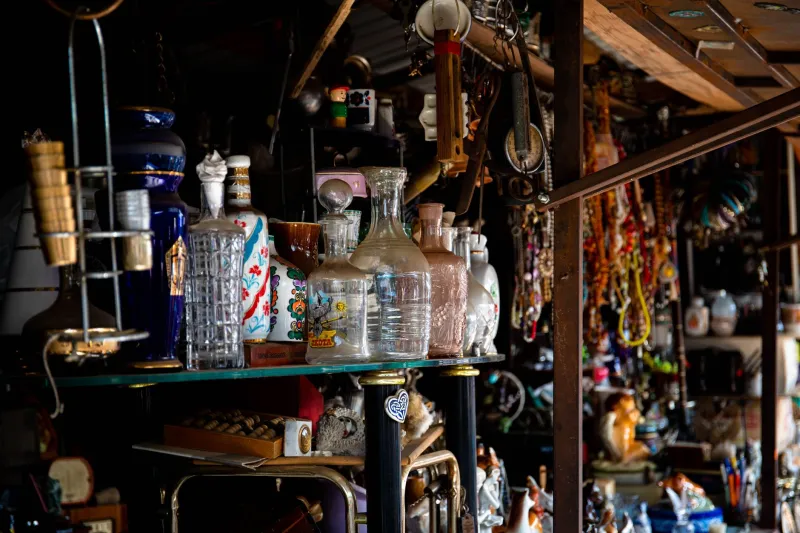
Every thrift store has one. Not officially — nobody's printing a sign for it — but every Goodwill, Salvation Army, and independently owned junk emporium in America has a shelf where the weird stuff migrates. The taxidermy that's seen things. The commemorative plate celebrating the 1987 retirement of a man named Gary from a paper company in Ohio. The oil painting of a couple's beach vacation, signed, framed, and abandoned by people who presumably moved on with their lives.
We call it the Cursed Shelf, and it might be the most honest place in America.
The Donation Box Is a Confession Booth
Talk to anyone who's worked a donation intake desk and they'll tell you: people give away the strangest things they own with the straightest faces imaginable.
"We got a full-sized mannequin once. Wearing a wedding dress. No note," says a former intake worker from a Midwest chain store who asked to remain nameless because, quote, "I still think about the dress."
Other legendary donations reported across the country: a shoebox of human baby teeth (labeled by year), a functioning gas pump, a ceramic ashtray shaped like a foot, and — in what has to be the most emotionally loaded item ever dropped off before close — a single wedding dress, worn, with the tags from a different, newer wedding dress tucked in the pocket.
The thrift store is where America's emotional overflow goes to be priced at $4.99.
A Field Taxonomy of Cursed Finds, by Region
After extensive (read: deeply unscientific) research, we've identified distinct regional flavors of weird:
The Southwest: Desert-Adjacent Hauntings. Painted skulls, legitimate cowboy memorabilia next to fake cowboy memorabilia, and decorative chili peppers in quantities that suggest someone lost a bet.
New England: Inherited Guilt Objects. Antique furniture with one broken leg, sold as "sturdy." Doilies. So many doilies. Cross-stitch samplers with threatening homespun wisdom like "Bless This Mess" hanging in a house that was clearly, historically, a mess.
The South: Religious Kitsch Crossover Event. Velvet paintings of Elvis, ceramic frogs dressed as churchgoers, and wall art of Psalm 23 rendered on what appears to be a slice of actual tree.
The Pacific Northwest: Unfinished Projects. Half-knitted sweaters, woodworking tools still in packaging, and a truly alarming number of accordions. Nobody in the Pacific Northwest finishes learning the accordion. They simply pass the torch.
Florida: No Notes. Everything There Is Its Own Category.
The Wedding Plate Problem
Let's talk about the single most abundant cursed object in America: the commemorative plate honoring a stranger's milestone.
Somewhere in this country, there is a couple — let's call them Denise and Craig — who registered for personalized wedding china, received it, displayed it for exactly one anniversary party, and then released it into the wild like a rehabilitated sea turtle. Now it lives at a thrift store in a state they've never visited, priced at $1.49, waiting for a stranger with a great apartment and no concept of boundaries to buy it and hang it above their bar cart.
And honestly? That's beautiful. That plate outlived the marriage, probably. It has achieved a kind of immortality Denise and Craig never could. The cursed shelf is not a graveyard. It's an afterlife.
The Employees Are the Real Archivists
Here's what nobody tells you about thrift store workers: they are the unofficial historians of American weirdness. They've seen the full arc of a suburban household — the wedding china, the baby gear, the exercise equipment bought in January and donated by March, the estate boxes full of a whole life sorted by grieving relatives who kept the photos and let the gravy boat go.
There's a poignancy under all the jokes. That hand-painted portrait of someone's ex? Somebody painted it with love, hung it with pride, and eventually decided their wall deserved better. Every cursed object was once somebody's treasure. The thrift store just holds them in the meantime, priced to move, waiting for the next round.
Go Find Your Cursed Object
The rules of the hunt are simple. Bring cash. Bring a friend who will enable your worst impulses. Do not ask "do I need this?" — the answer is always no, and that is entirely the point. Ask instead: "Will I think about this object for the rest of my life?"
If the answer is yes, congratulations. You've just adopted a piece of the Cursed Shelf. Water it occasionally (dust it, actually), tell guests its story with total confidence, and know that someday, decades from now, someone else will find it on a shelf and wonder about you.
That's not junk. That's a relay race.