Odd Duck, Rising Star: How Your Weirdness Was Always the Point
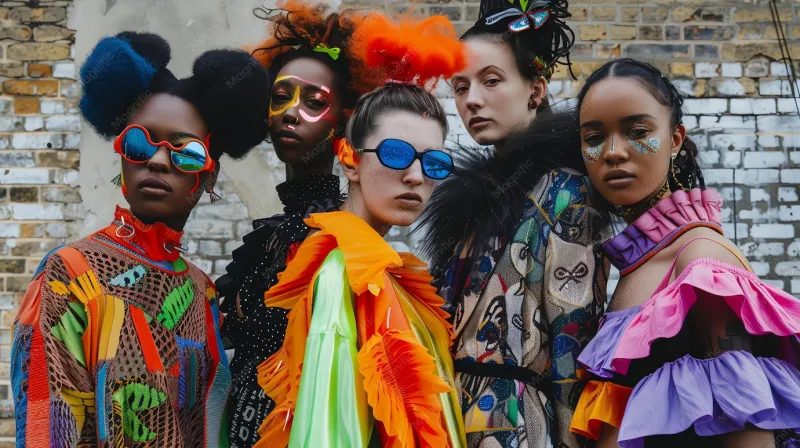
Photo: confident quirky woman colorful unique style standing out crowd, via img.freepik.com
Let's set the scene. It's third grade. You're wearing a cape to school — not for Halloween, just because capes are objectively superior to regular jackets — and someone in your class says, with the full weight of eight-year-old judgment, "That's so weird."
You probably went home and hid the cape. But here's the thing: the cape was never the problem. The problem was that nobody told you the cape was, in fact, your entire personality's founding document.
Welcome to the Weird Girl (and Weird Guy, and Weird Everyone) Era — a cultural moment where the oddballs, the overly-specific, and the socially sideways are finally being recognized not as misfits but as the most interesting people in any room.
Weird Isn't a Bug. It's the Whole Feature.
For a very long time, American culture ran a pretty tight script. Cool was cool. Normal was safe. Anything outside the lane — the kid who collected vintage radio parts, the teenager who was inexplicably obsessed with Victorian mourning jewelry, the adult who hand-sews elaborate costumes for their houseplants — was filed under "bless their heart."
But something shifted. Maybe it was the internet giving every niche its own corner of the universe. Maybe it was the pandemic forcing everyone to sit with themselves long enough to realize they had genuinely strange inner lives. Maybe it was the slow, collective exhaustion of performing normalcy for people who weren't even paying attention.
Whatever the catalyst, we are now living in the golden age of the Authentic Weirdo, and honestly? It looks incredible on us.
Creativity researchers have long argued that divergent thinking — the ability to make unexpected connections, to see patterns others miss, to approach problems sideways — is one of the most valuable cognitive traits a person can have. And who, historically, has had the most practice thinking sideways? The people who were never allowed to think straight in the first place.
The Competitive Edge Nobody Teaches You About
Take Sasha, a 29-year-old graphic designer in Austin who spent her entire adolescence being mocked for her obsession with obscure Soviet-era propaganda posters. She papered her room with them. She wrote her high school history paper about them. She got approximately zero dates because of them.
Today, she runs a boutique design studio whose entire visual identity is built on bold, flat, maximalist aesthetics pulled directly from that teenage obsession. Her clients — tech startups, indie food brands, music labels — pay a premium for a perspective they cannot find anywhere else. Her weirdness, fully leaned into, became her trademark.
Or consider Marcus, a 34-year-old in Brooklyn who has been doing competitive yo-yo since he was twelve. He never stopped. While everyone else was trying to seem effortlessly cool, Marcus was in his basement perfecting string tension. He now has 200,000 followers on social media, a sponsorship deal, and a community of people who found him specifically because he was doing something no one else was doing.
This is not a coincidence. Specificity is magnetic. Oddness, when worn with confidence rather than apology, reads as authority. People don't follow the person who likes things — they follow the person who is inexplicably, specifically, deeply into one particular thing in a way that makes you want to know more.
The Social Math Nobody Showed You
Here's what they don't tell you in school: trying to be universally liked is a losing game. It's a numbers problem. If you sand down every sharp edge, every weird corner, every unexpected angle of your personality to appeal to the broadest possible audience, you end up appealing to no one in particular. You become beige. Inoffensive. Forgettable.
But when you show up as the person who has Strong Opinions about the correct way to organize a spice cabinet (alphabetical is chaos, flavor profile is civilization), or who has seen every single monster movie made between 1954 and 1978, or who insists on wearing exclusively vintage clothing from the 1940s to the grocery store — you become findable.
Your people, the ones who will genuinely love you, need something to locate you by. Your weirdness is the signal. The right ones will always find the frequency.
This is especially true in creative fields, but it's increasingly true everywhere. Hiring managers talk about "culture add" rather than "culture fit" now, specifically because companies have realized that rooms full of similar thinkers produce similar (read: boring, fragile) ideas. The weird hire, the one who approaches the quarterly report like it's a puzzle box and brings up references no one expected — that's the person who actually moves things forward.
How to Stop Apologizing for the Best Parts of You
If you've spent years in cape-hiding mode, the transition back to full weirdness isn't always graceful. That's okay. You don't have to announce it. You don't have to post a manifesto. You just have to stop shrinking.
Start small. Mention the obscure thing you love in a conversation and don't immediately follow it with "I know, I know, it's so weird." Just let it sit there. Watch what happens. More often than you'd expect, someone across the table lights up and says, "Wait, me too."
Or nobody says anything and the conversation moves on, and you realize the stakes were never as high as you thought.
Wear the cape. Metaphorically, or literally — no judgment here. Your strangeness has been quietly doing the work of making you you this whole time. The least you can do is introduce it properly.
At Sasa Panda, we've always believed the weird stuff is the good stuff. The unexpected corner of your personality isn't the part to hide — it's the part worth building around. So if you've been waiting for permission to fully commit to your particular brand of odd, consider this your green light.
The cape was always the best part of the outfit.

